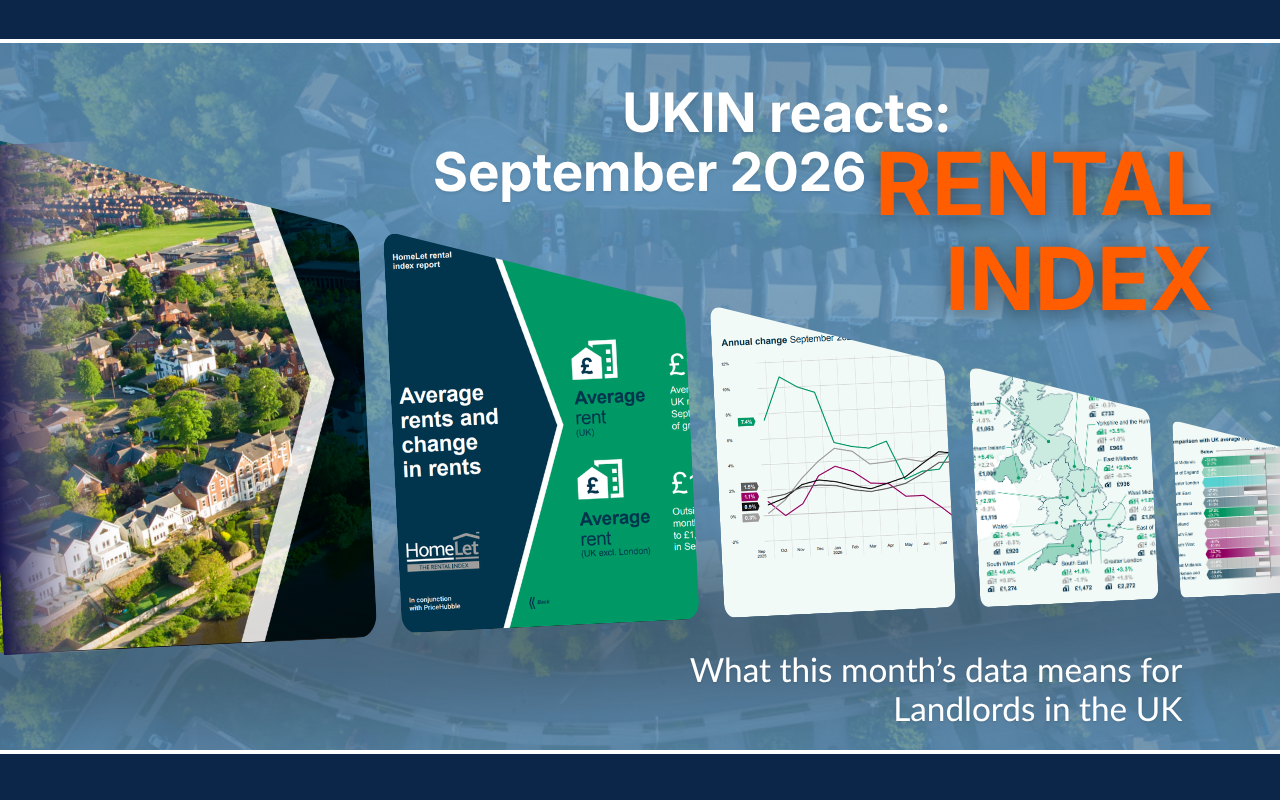
Record rents, uneven realities: what September’s Rental Index means for landlords
Average UK rents reached a new high in September 2026, but the headline tells only part of the story.
The HomeLet Rental Index September 2026 puts the average monthly rent at £1,387, up 3.3% on a year earlier. Yet annual growth has slowed, and rents outside London fell slightly compared with August.
For landlords, that distinction matters. A national record offers useful context, but it does not tell you what your own property can achieve or how much rental income you will retain after costs.
Drawing on data from HomeLet, UKIN’s sister company within Barbon Insurance Group Ltd, we explore what September’s figures mean for landlords, and how understanding local conditions can bring those figures into focus.
September 2026 UK rental market at a glance
| Measure | September 2026 | Change from August | Annual change |
| Average UK monthly rent | £1,387 | +0.4% | +3.3% |
| Average monthly rent excluding London | £1,176 | −0.3% | +3.1% |
| Average London monthly rent | £2,272 | +1.5% | +3.3% |
Source: HomeLet Rental Index, September 2026. Figures relate to agreed rents for new tenancies
Annual UK rental growth eased from 4.1% in August to 3.3% in September. That does not mean rents fell nationally: average rents still rose, but the annual rate of increase was slower.
For landlords, separating the level of rents from the pace of growth is important.
A record national rent is not a local pricing strategy
The contrast between the UK-wide increase and the monthly decline outside London is a reminder that national averages cannot capture every landlord’s experience.
Outside London, average rents were £1,176, down 0.3% month on month, although still 3.1% higher than a year earlier. London, meanwhile, recorded a monthly increase of 1.5%.
How those trends translate to individual properties will vary across local markets.
A useful question for landlords to consider is: what rent is realistic for this property, in this location, under current market conditions?
That means considering comparable properties, their condition and features, and the rents being achieved locally.
How can I use the HomeLet Rental Index?
Start with your region. The average rent gives you a feel for what tenants are paying, based on rents actually agreed rather than advertised asking prices. Then look at the monthly and annual changes together: has rent risen recently, and how does that compare with a year ago? This helps you see whether the latest movement is part of a longer-term trend.
Next, bring it closer to home. How does your property compare with similar homes nearby – in size, condition, features and location – and what rents are they achieving? Those local comparisons help explain where your property sits within the regional picture. The more familiar you become with the data, your local market and national trends, the more confident you’ll feel discussing rent – and the clearer your sense of what’s realistic for your property will be.
How do rental trends vary by region?
September’s regional figures show how different a local picture can be.
Northern Ireland and the South West jointly recorded the strongest annual rental growth, at 5.4%. Wales, by contrast, recorded an annual decline of 0.4%.
Even within London, the report shows considerable variation: annual rental changes ranged from −3.6% in Tower Hamlets to +10.7% in Wandsworth.
For landlords with properties in different locations, this is particularly relevant. A rent review that makes sense for one property may not be appropriate for another, even within the same portfolio.
The practical lesson is simpler: assess each property on its own merits, rather than applying one headline percentage across a portfolio.
Rental affordability: what is left to live on?
A household’s income tells you what is coming in; rental affordability considers how much of that income goes towards rent. For landlords, the important question is not simply whether a tenant can meet the monthly payment, but whether they can do so consistently while still covering essentials such as food, energy, transport and other commitments.
HomeLet reports that UK renter households spent an average 32.1% of gross household income on rent in September, compared with 32.0% a year earlier. In the North East, that share rose more noticeably, from 30.0% to 31.8%, despite average monthly rent being £732. A lower rental amount does not automatically mean a more affordable home: it depends on the income available to support it.
These figures use income before tax, so they don’t show what tenants actually have left to spend. For landlords, it helps to look beyond whether someone earns enough to cover the rent and consider what’s left once tax, bills and other regular costs are paid. Can they comfortably cover everyday essentials too? That’s the difference between being able to pay the rent and being able to keep paying it over time.
An achievable rent and an affordable tenancy should be considered together. The aim is not simply to identify the highest possible figure, but to make an informed decision about the property and the tenancy. And, if you think you’ve found the ideal tenant for your property let, but are still concerned about the potential of arrears, take a look at our Rent Guarantee Insurance option for your consideration and peace of mind.
What should landlords review now?
September’s figures provide an opportunity to take stock and reflect on how your property compares with the local market ahead of your next rent review.
Benchmark the property locally
Compare similar properties in the same area, taking account of size, condition and features. Use the national and regional figures as context, not a target.
Consider affordability alongside achievable rent
Look at the tenancy as well as the property. Market demand and household affordability are relevant considerations, rather than reasons to assume every tenant can absorb the same increase.
Review the full annual financial picture
Consider rental income alongside maintenance expenditure, expected costs and any time the property may spend empty. A record national rent does not replace a property-level budget.
Check your financial resilience and insurance
Review your reserves and existing insurance alongside the risks associated with the property. Consider Rent Guarantee Insurance if you want extra security for your rental income. Always check the cover, limits, exclusions and conditions.
The takeaway: Understanding your local market starts with understanding the data.
September’s Rental Index shows a market in which record rents, slowing annual growth and differing local conditions exist together.
For landlords, the value lies in understanding those differences, not simply following the national average.
HomeLet provides the market evidence. Local comparisons, household affordability and a realistic view of costs help translate that evidence into decisions about your property.
The strongest rental strategy is not necessarily the one built around the largest increase. It is one grounded in the property’s market, the tenancy and the sustainability of its income.
About the source
This article draws on the HomeLet Rental Index, September 2026. The index uses tenant-referencing data to measure agreed rents for new tenancies starting in the reporting month. Its mix-adjusted methodology accounts for changes in property types and locations.
It does not measure advertised asking rents or every existing tenancy. Affordability figures relate to gross household income, before tax and other living costs.
Source: HomeLet. Report analysis and production credited to Dataloft, in conjunction with PriceHubble.