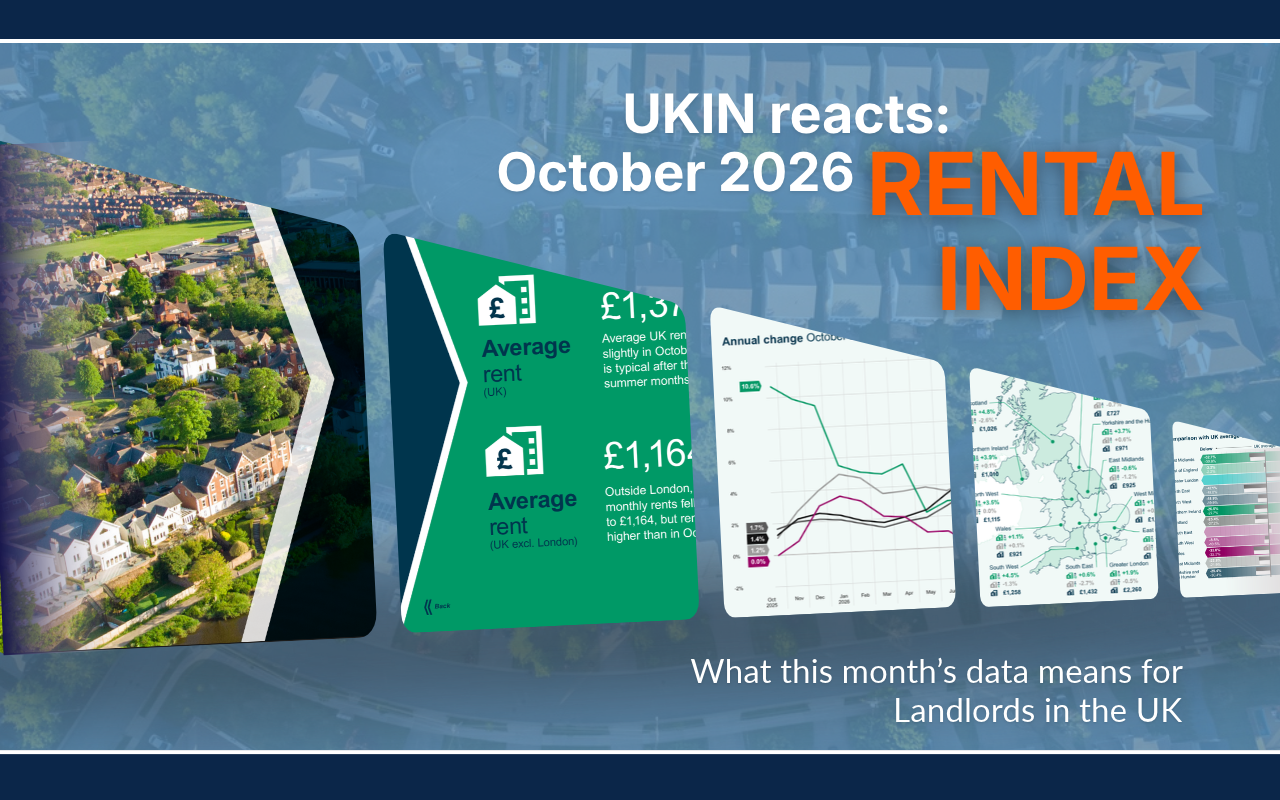
After rents reached a record high in September, the latest HomeLet Rental Index shows a small easing in October.
The HomeLet Rental Index for October 2026 shows that the average UK rent was £1,375 per month: 0.9% lower than in September, but 2.2% higher than a year earlier. Scotland recorded the strongest annual rental growth at 4.8%, while the average rent in London was £2,260 per month.
For landlords, the figures provide a starting point for reviewing rents alongside comparable properties in each area. The index uses tenant-referencing data and achieved rents for new tenancies, rather than advertised rents, and does not represent every existing tenancy.
Here’s a closer look at the October figures and what they could mean for you.
UK rents ease after September’s record high
| Area | Average monthly rent | Change since September | Change since October 2025 |
|---|---|---|---|
| UK | £1,375 | -0.9% | +2.2% |
| UK excluding London | £1,164 | -1.0% | +2.3% |
| Greater London | £2,260 | -0.5% | +1.9% |
The average UK rent fell by 0.9% in October, following a 0.4% rise in September. Annual growth also slowed, from 3.3% in September to 2.2% in October.
The report notes that a slight easing is typical after the busier summer months. So, while the change is worth noting, one month’s figures don’t necessarily tell us what will happen next.
Outside London, the average rent fell from £1,176 in September to £1,164 in October. It was still 2.3% higher than a year earlier.
The picture varies across the regions
While UK-wide figures give an overview of the rental market, regional data offers a closer look at the trends shaping your area. October’s figures highlight a range of changes across the UK:
- Scotland recorded the strongest annual growth, with rents up 4.8%, despite a monthly fall of 2.6%.
- The South West saw annual growth of 4.5%, alongside a monthly fall of 1.3%.
- The South East recorded a monthly fall of 2.7%, while rents remained 0.6% higher than a year earlier.
- The East Midlands saw rents fall by 0.6% annually.
- Wales recorded annual growth of 1.1%, compared with an annual fall of 0.4% in September.
In September, Northern Ireland and the South West shared the strongest annual growth at 5.4%. In October, Scotland moved to the top of the annual growth table.
What’s happening in your area? Explore the full report for a closer look at regional trends and use the figures alongside comparisons with similar properties nearby, taking their location, size and condition into account.
London rents fall slightly
The average London rent fell from £2,272 in September to £2,260 in October, a monthly decrease of 0.5%. That followed a 1.5% increase in September.
London rents were still 1.9% higher than a year earlier, although annual growth had slowed from 3.3% in September. As always, a London-wide average won’t reflect every neighbourhood, so it’s worth checking the market around your own property.
Affordability remains an important consideration
In October, UK renters spent an average of 32.7% of gross household income on rent, compared with 32.1% in September. In London, the October figure was 38.9%.
For landlords, finding the right rent is about balancing your costs with what tenants can reasonably afford. A competitive rent is important, but so is a sustainable tenancy and a property that tenants are happy to stay in.
Looking after your property as winter approaches
With the rental market easing after the summer and Christmas on the horizon, this can be a useful time to review the condition of your property as well as the rents being charged.
Checking that heating is working, addressing known maintenance issues and making sure tenants know who to contact in an emergency can all help you prepare for colder weather. Planning ahead may also help you manage unexpected costs and disruption.
If you’re considering additional protection, our guide to landlord home emergency cover explains what it typically covers and what to check before buying.
Staying on top of changes as well as rents
The Rental Index can help you understand how the market is moving, but it’s just one part of managing a rental property. Landlords in England should also keep an eye on the upcoming Register your Rental Property service and what they’ll need to do as it rolls out.
Our guide to the new rental property register explains what the service means for landlords and letting agents. The registration service applies to England, whereas the HomeLet Rental Index covers the UK.
The overall UK Rental Market October 2026 takeaway
October’s figures show that rents have eased since September, but remain higher than a year ago in most regions. For landlords, there’s no need to react to one month’s change in isolation.
Instead, use the index as a starting point: look at your local market, consider affordability, and make sure your property is ready for the months ahead. A little preparation now can help you feel more confident heading into winter and the new year.
The HomeLet Rental Index uses tenant-referencing data and achieved rents for new tenancies, rather than advertised rents. It does not represent every existing tenancy.